
AI for Reliability: Between Promise and Practice
At Domtar, Tor Idhammar is exploring where artificial intelligence can genuinely strengthen reliability, and where enthusiasm for technology risks distracting organisations from the fundamentals.
At Domtar, reliability is not a technical side issue. It is a condition for remaining competitive in an industry shaped by global price pressure, complex production assets and narrow margins. As Director of Reliability, Tor Idhammar supports approximatelysixty facilities with a total of 13,000 employees across North America. At the Asset Performance Conference, he will bring a deliberately grounded perspective to one of the most discussed topics in industry today: artificial intelligence.

His opening keynote, AI for Reliability at Domtar: Hype, Help, or Hard Truths?, will not celebrate technology for technology’s sake. It will examine the gap between what AI promises, what industrial organisations can realistically implement and what still has to happen on the plant floor.
“AI is a great tool, but today it is sometimes presented as a solution for almost everything,” Idhammar says. “We need to remember that, at the end of the day, someone still has to turn the wrenches and do the repair.”
Reliability at industrial scale
Today’s Domtar is the result of several companies coming together over the past few years. The group operates around sixty facilities in the United States, Canada and Mexico, including pulp and paper mills, board manufacturing sites, sawmills and converting facilities.
That scale creates complexity. Every mill has its own history, workforce, asset base and level of reliability maturity. For example, the company operates several different CMMS and five versions of SAP. A practice that is well established at one location may still be under development at another.
“The pulp and paper industry faces many challenges,” Idhammar explains. “We compete for resources, while at the same time there is strong global price pressure. Margins are relatively small, so operational excellence and reliability are essential.”
Idhammar’s role is corporate, but the mills do not report to him directly. He describes himself as an internal consultant: someone who supports the sites, challenges existing practices and helps local teams translate corporate direction into improvement.
Tors experience builds on almost three decades at reliability consultancy IDCON. That experience gave him a broad view of successful reliability organisations, and of why improvement programmes so often stall after the initial enthusiasm.
“I have seen many sites, many locations and many different industries,” he says. “In short, I have seen what “good” looks like.”
Seeing what good looks like, however, is only part of the challenge. The decisive question is whether an organisation can translate that knowledge into different daily behaviours.
A strategy simple enough to use
One of Idhammar’s first assignments at Domtar was to develop a company-wide reliability strategy. The real challenge was not to make the strategy comprehensive, but to keep it practical. A mill manager must balance safety, production, quality, costs, environmental performance and people. A reliability model that becomes too broad risks turning into another corporate document that receives attention during its launch and little attention afterwards.
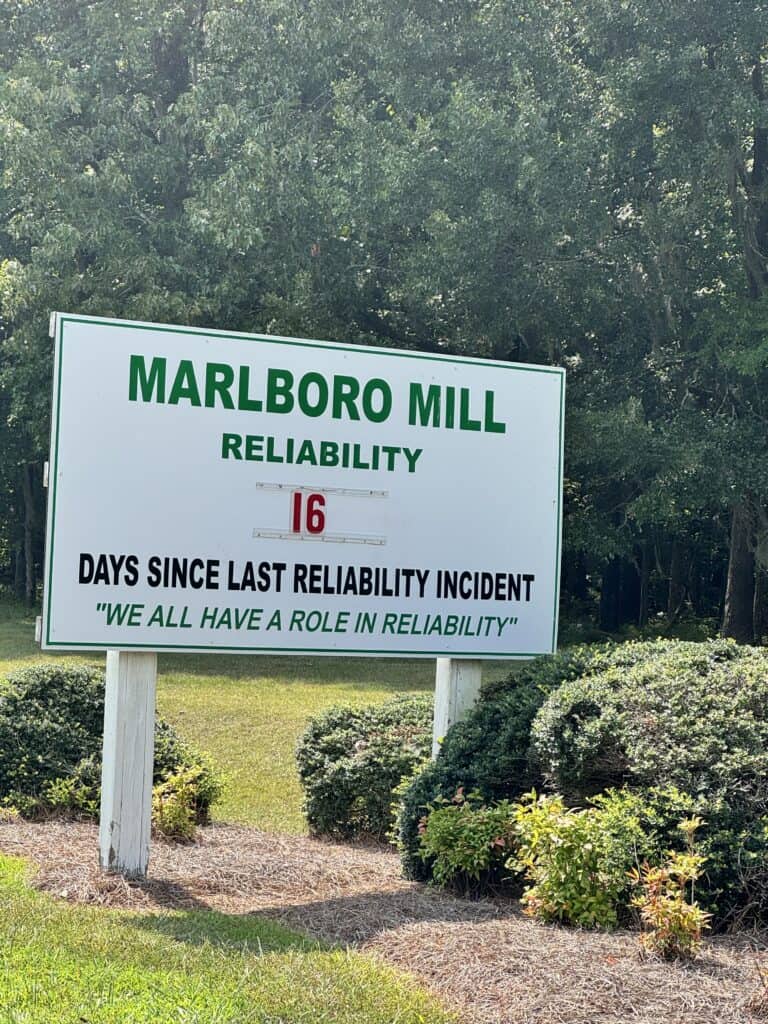
Domtar therefore created a feedback loop around the strategy. Each mill assessed its own gaps and translated them into a local reliability roadmap. Progress is reviewed regularly with the appropriate management teams. “It is a simple plan-do-check-act loop,” Idhammar says, “but it works well precisely because it is simple.”
The approach avoids forcing every facility to work on the same themes at the same time. A mill without effective planning needs a different starting point from a mature facility that is ready to improve predictive maintenance or introduce more advanced reliability practices.
“You need to meet each mill where it is,” he says. “For ownership and buy-in, the mills themselves need to identify their gaps and decide what they will work on.”
Corporate leaders can challenge priorities and highlight weaknesses that a local team may have underestimated. Nevertheless, each roadmap must reflect the maturity, available resources and operational reality of the individual mill.
This balance between corporate direction and local ownership also shapes Domtar’s exploration of artificial intelligence.
The hard truths behind the AI conversation
Domtar is testing several AI-related applications in reliability. Idhammar is careful, however, not to present the company as having already found a universal model. The projects are intended to clarify where AI can create value, what infrastructure is required and which limitations remain.
The first hard truth is that AI depends on much more than an algorithm.
“If you start collecting large amounts of data, that data needs to flow somewhere,” he says. “Servers can quickly become overloaded. Connectivity can become an issue. If you install sensors, you need to know whether those sensors are measuring the right things.”
Sensor validation, calibration, connectivity and data architecture may not be the most exciting parts of an AI project, but they determine whether the technology can function in an industrial environment.
A second hard truth concerns failure data. Many AI systems in maintenance focus on anomaly detection. The model learns what normal behaviour looks like and signals when a pattern begins to deviate. That can be valuable, but an anomaly is not yet a diagnosis.
“The system often does not know what the anomaly actually means,” Idhammar explains. “It can tell you that something is abnormal, but not necessarily what the failure mode is or what action should be taken.”
The difficulty becomes clearer when dealing with long-lived industrial assets. A critical motor may operate for many years before experiencing a failure. That is precisely what a reliability organisation wants, but it also means there may be relatively few labelled failure examples available to train a model.
The assets for which companies most want predictive insight may therefore not fail frequently enough to provide the clean learning data that many systems require.
Human expertise remains essential. People must validate alarms, interpret patterns, connect observations to known failure modes and determine what action should follow. Domtar is also examining whether existing engineering knowledge, such as thresholds, alarm limits and established rules, can be introduced earlier to accelerate the learning process.
These are the practical questions Idhammar will explore at the conference: not to dismiss AI, but to place it inside the operational system it must ultimately serve.
When technology meets weak fundamentals
AI may support condition monitoring, reduce administrative work, process large volumes of information and improve decision support. Yet a technology investment does not automatically translate into better reliability.
At many maintenance conferences, Idhammar observes, the conversation has shifted from pumps, planning, craft skills and maintenance execution towards software, platforms and analytics. Meanwhile, the physical work still has to be performed.
“We do not yet have robots doing all the maintenance work,” he says. “We do not have 3D printers replacing the storeroom. Those technologies may develop further, but they are not the current reality for most plants.”
For technical managers, the uncomfortable question is not whether AI is impressive. It is whether the investment addresses the organisation’s most important reliability constraint.
A company may invest heavily in an AI solution while work notifications remain poorly prioritised, preventive maintenance routes are weak, planners lack training or repairs are performed inconsistently. Condition Monitoring using AI may then generate more failure alarms without improving the organisation’s ability to respond to them.
“Sometimes companies spend significant amounts of money on AI, while the same investment in training craftspeople, training planners, improving prioritisation or strengthening change management might deliver greater reliability gains,” Idhammar says.
The fundamentals may be less glamorous, but they are often where the most immediate value remains.

Where reliability is really won
Asked about the strongest levers for improvement, Idhammar returns to three closely connected areas: inspections, work prioritisation and maintenance prevention.
Inspections include predictive maintenance, condition monitoring and the systematic detection of equipment degradation. This is where many AI applications are currently concentrated, but technology does not eliminate the need for competence.
A skilled mechanic walking through a plant uses sight, sound, touch and smell, supported by instruments such as temperature, stroboscopic or vibration tools. More importantly, that person understands the machine within the wider production process.
“A good inspector understands the overall system and the equipment in its context,” Idhammar says.
Robotic and AI-enabled inspections are advancing, but reproducing that contextual understanding remains difficult. A plant that replaces skilled observation with data collection alone may create new blind spots.
Work prioritisation represents another major opportunity. Maintenance teams face a constant stream of notifications, requests and identified defects. Without disciplined triage, urgent work, important work and low-value work compete for the same limited resources.
Idhammar compares the process to a hospital emergency department. Teams must decide what requires immediate attention, what can wait and what should not be done at all. Better prioritisation can eliminate unnecessary work and ensure that the available maintenance capacity is directed towards the assets and risks that matter most.
Maintenance prevention concerns the work that stops defects from being introduced in the first place. Correct lubrication, precision alignment, proper installation, appropriate bolt tightening and high-quality repairs all influence asset life directly.
Domtar has invested in an extensive precision maintenance programme in which craftspeople develop practical skills around pump-motor systems, alignment, balancing, installation and bolting. The training is spread across approximately a year, underlining that competence cannot be created during a single classroom session.
For Idhammar, this is not separate from the digital reliability agenda. It is the foundation that determines whether digital insights will lead to better outcomes.
Keeping the human in the loop
As organisations become more data-driven, physical interaction with equipment may decrease. Yet inspectors, mechanics, electricians and lubricators may become more important rather than less. They provide context that systems do not automatically possess and recognise weak signals that may be difficult to capture as structured data.
A lubricator, for example, may be one of the few people who routinely visits a large number of assets. The potential value of that position depends on training, clear expectations and the ability to report and act on observations.
“Keeping the human in the loop remains essential to ensuring the reliability of our mills,” Idhammar says.
That statement captures the central tension behind his keynote. AI can help reliability teams see more, process more and perhaps act earlier. But it cannot yet replace the organisational discipline, technical competence and management commitment that make reliability possible.
Support from senior management is especially decisive. Idhammar made this clear when he accepted his current role. Reliability should not merely be supported by leadership; it must be driven by leadership.
A corporate reliability team can provide expertise, direction and challenge, but mill managers and operational leaders ultimately determine whether priorities change, resources become available and new practices are sustained.
Without that commitment, even the most sophisticated technology is unlikely to close the gap between identifying a problem and solving it.
A keynote for the next investment decision
Idhammar’s presentation will be especially relevant for technical managers who are being asked to define an AI strategy, evaluate new solutions or justify digital investments while still dealing with long-standing maintenance challenges.
The session will not offer a simplistic choice between traditional reliability and digital transformation. Instead, it will examine how the two must reinforce each other: why promising technologies can underperform, why management support remains decisive and why the quality of basic practices still determines the return on advanced tools.
Engineers are naturally attracted to new technology, Idhammar acknowledges. He is no exception. New tools are interesting, and the potential applications of AI in reliability are significant. But curiosity must be combined with operational judgement.
“We should not get derailed,” he says. “Basic reliability practices may not always be glamorous, but they are still essential.”
At the Asset Performance Conference, his challenge to the audience will be clear: look beyond the promise of the tool and examine the system in which it must work.
The future of reliability may be increasingly intelligent, connected and automated. Progress will still depend on choosing the right problems, building the right foundations and ensuring that people can turn information into action.